Showing posts with label Disney. Show all posts

Friday, May 2, 2014

The Nine Old Men

The term “Nine Old Men” is ubiquitous in the world of animation and Disney animation alike. It was the moniker given to Disney’s core group of animators, who’ve worked with the company for roughly fifty years. In addition, they’re credited for refining the twelve principles of animation. The Group consisted of Les Clark, Woolie Reitherman, Eric Larson, Ward Kimball, Milt Kahl, Frank Thomas, Ollie Johnson, Johnny Lounsbery,  Marc Davis:
Les Clark
Link
            Walt Disney hired Les Clark in 1927, originally unsure how long Clark would last and believed that would last only as a temp. Clark worked for Disney until his retirement in 1976. Frank Thomas and Ollie Johnston (1981) noted Clark’s skill:
His drawings had appeal, were always gentle and warm and likable, and his timing was always sensitive. He quietly went ahead perfecting what he did best, constantly at art class working hard to improve and to learn. There was much adoration for this quiet, thoughtful man, who came in with no art background yet through sheer determination and desire not only kept up but helped advance the art with his refinements of many fundamentals. (pp. 168)
Clark was responsible for animating Mickey Mouse in Fantasia’s “Sorcerer’s Apprentice” sequence as well as the Sugar Plum Fairies in the “Nutcracker Suite.”  
 In addition, he was appointed Sequence Director on Sleeping Beauty.
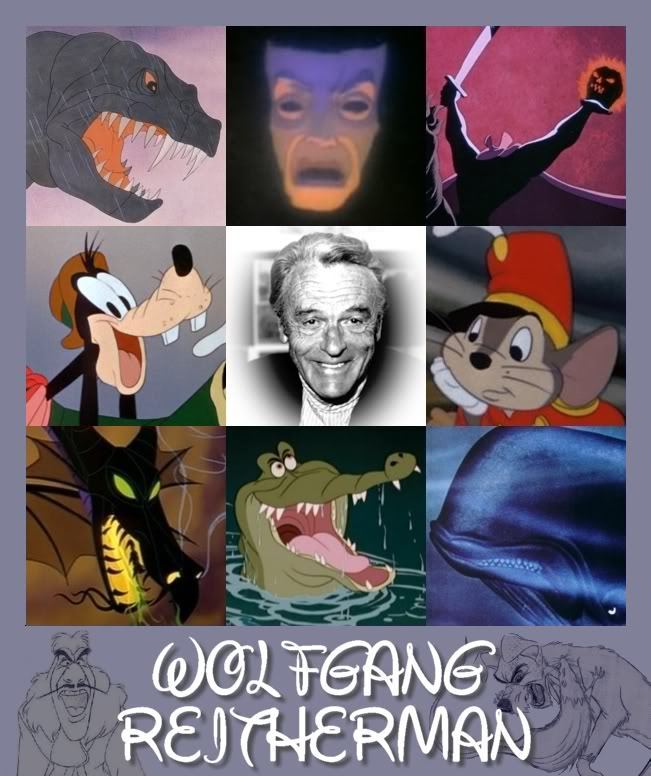
Woolie Reitherman
            Wolfgang “Woolie” Reitherman was described by his peers as, “the most physical of the group­ – with a compulsion to stay young and to squeeze in everything before it is too late” (Johnston and Thomas, 1981, p. 169). Reitherman’s work includes Monstro from Pinocchio, the crocodile from Peter Pan, and directed all of the Disney films after Disney’s death as well as responsible for animating and directing Goofy in the Goofy shorts. According to Thomas and Johnston (1981), “his timing, staging, texture, pacing, desire to do something different, good gag sense, knowledge of whether it was entertaining (and the ability to think of something else if it was not), all carried over into his directing” (p. 169). He was a ball of boundless energy that always provided fresh, new material.
Eric Larson
Link
            Eric Larson was talented at animating pantomime, Figaro from Pinocchio and the pegasi from Fantasia’s “Pastoral Symphony.” In addition, Larson worked on the rogue stag and the Old Owl in Bambi. Because of his history animating birds or flying creatures, Larson became known as a “bird-man” for being able render flying creatures with expertise.
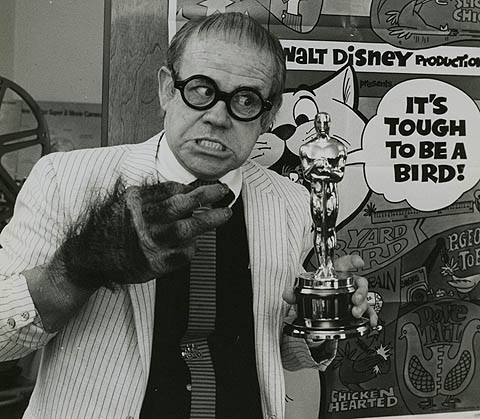
Ward Kimball
            Ward Kimball originally started in character animation as well as animating beloved character Jiminy Cricket. However, he felt it was too stifling for his talent. Kimball found his true calling as the joker of the team:
Link
                        He was an excellent draftsman, with the rare ability to make funny drawings equally as well as serious ones. He had a better design sense than most and thought imaginative ways of doing things. He never did what was expected, and to the consternation of at least one director never did the assignment the way it was handed out. His staging was tops, his timing unique, and he could show what was funny about a situation. He had a knack for picking out the special, little noticed traits in almost everyone around him, and from then on that person would have a label on him. (Johnston and Thomas, 1981, p. 171)
Link
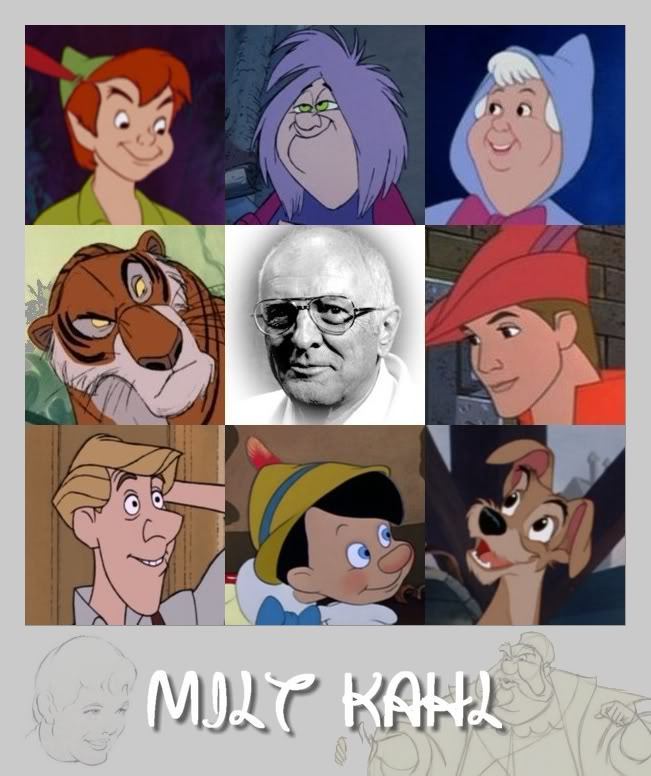
Milt Kahl
            According to Johnston and Thomas (1981) Milt Kahl’s greatest asset, “lay in his drawing ability and his conviction that animation drawings were really two-dimensional and should work in that plane – clear, simple, easy to read and understand” (pp. 171). Kahl was the most talented at being able to animate human figures without relying on live-action or the support of reference material. In addition, Kahl was noted for his eye in design, being responsible for Sir Ector and Kay in The Sword in the Stone and Madame Medusa in The Rescuers, the latter being his answer to Cruella de Vil and the final character he would animate before his retirement.
Frank Thomas
Link
            Frank Thomas, co-author of the book The Illusion of Life: Disney Animation, and fellow Old Man. Thomas is not as talented as an animator, nevertheless, he has been noted to have an analytical eye:
                        Like the rest of his fellows, Frank gave time to help others. His advice was sought on music, layout, background, and story as well as the animation. On the last few features, Frank would spend anywhere from six months to a year helping develop the story structure and situations, sharpening up and defining the characters and  their dialogue – and then he would animate on those same sequences with a fresh eye. (Johnston and Thomas, 1981, p. 174)
Thomas was also famous for his decades long friendship with fellow animator, Ollie Johnston.
Ollie Johnston
Link
            Ollie Johnston, co-author of The Illusion of Life: Disney Animation and fellow Old Man.
Colleagues agreed that Ollie carried acting and the feeling of the characters to the highest point. He had a sensitivity for good picture, imaginative layout, what the character should be doing, and how to arrange the scenes for the best effect. His knowledge of what was needed in a voice made him valuable in dealing with the difficult decisions of whether the vocal talent was giving the performance he must have to make the character think and act. (Johnston and Thomas, 1981, p. 174)
For example, Johnston was involved in animating the Queen of Hearts and trying to find that right balance between pompous ruler and violent womanchild, yet nevertheless finding the comedy and entertainment value out of it. In addition, Johnston was also famous in the world of animation for his decades long friendship with Frank Thomas.
Johnny Lounsbery
            Johnny Lounsbery was originally instructed by original Disney animator Norm Ferguson himself. However, Johnston and Thomas (1981) noted in more ways than one of the student surpassing the master:
Link
His better drawing and bigger concept, not limited by old vaudeville acts,   brought the bold, crude approach to new heights, using more refinement , more dramatic angles, more interest, and all without losing the main idea. His simple staging, appealing characters, good taste, strong squash and stretch, and controlled anticipations and follow through made a big bold statement, but they never lost believability. Hardly subtle, his characters were always fun to watch. (pp. 176)
Lounsbery’s favorite character he animated wa Ben Ali the alligator from “Dance of the Hours” in Fantasia. Lounsbery was noted by his peers to be an introvert though it never stopped him from asserting himself in key decisions. Also, he was very good in working with live-action and capable of blending it with cartoon action without losing the subtleties of either medium. Lounsbery passed away during the production of The Rescuers which he was serving as sequence director.
Marc Davis
Link
            Marc Davis slowly rose in Disney animation, starting with clean up and delicate drawings on Snow White to designing and animating Disney’s greatest villains, Maleficent and Cruella de Vil. Despite this, Marc was described, “a very gentle person, but with strong convictions that he holds to tenaciously” (Johnston and Thomas, 1981, p. 177). Johnston and Thomas (1981) note Davis’ tendency to the dramatic”

…the flamboyant Cruella de Vil made use of everything from her bony elbows to her posturing through her erratic movements….Maleficent, he showed a flair for the dramatic based more on powerful shapes in his design and strong use of color than on broad action. He had a feeling for the importance of a good layout and never overlooked the value of props such as the raven and the staff and made sure they were part of the overall picture. (pp. 177)


Works Cited
Johnston, O., & Thomas F. (1981). The Illusion of Life: Disney Animation. New York: Disney Editions.  

Sunday, March 2, 2014

Introduction

For the past eighty years animation has held the image of a genre that caters to children and the young at heart. I disagree with this sentiment, animation is a medium. It’s a common misconception to assume animation and cartoons are strictly for kids, thanks to big animation studios like Disney, Pixar, and DreamWorks saturating the market. However, like the medium of film, which can tell a wide variety of genres and stories that can be told and appeal to a wide audience, both young and old; so can animation. For example, even though their work is geared towards children, Pixar still conveys enough material for adults and artists to enjoy. The films they’ve created feature timeless stories, they’ve delved into mature thematic material regardless of their audience, and scenes and characters that we find ourselves emotionally invested.    
As famed animators Frank Thomas and Ollie Johnston (1981) once said:
What you as an animator are interested in is conveying a certain feeling you happen to have at that particular time…. Conveying a certain feeling is the essence of communication in any art form. The response of the viewer is an emotional one, because art speaks to the heart. This gives animation an almost magical ability to reach inside any audience and communicate with all peoples everywhere, regardless of language barriers (p. 15).
            However, getting a viewer to respond and emotionally invest in a character is tricky. Animators look at expressions, symbols, and signifiers that an audience member can identify with:
We start with something they know and like. This can be either an idea or a character, as long as it is familiar and appealing. It can be a situation everyone has experienced, an emotional reaction universally shared, a facet of someone’s personality easily recognized, or any combination of these…. The audiences will make our little cartoon character sad––actually, far sadder than we could ever dram him––because in their minds that character is real. He lives in their imaginations (Johnston & Thomas, 1981, p.19).
They then go into detail that for an animated cartoon character to be real, he must have personality, and preferably an interesting one. For example, the earliest cartoon character with a distinct personality would be Gertie the Dinosaur by Winsor McCay.  
 It was believed McCay used a cat for reference when animating Gertie, given that the dinosaur displayed cat-like tendencies like pawing or kneading the ground. Nonetheless, Gertie conveyed shyness, stubbornness, and a fragile self-esteem: traits that mark a distinct personality. Later, Thomas and Johnson use Donald Duck, who is known for his explosive temper, best represented when he’d break a golf club in half in frustration.

            Animation is a medium, not a genre. It is the art and science of bringing imagination to life:
The illusion of life is a rare accomplishment in animation, and it was never really mastered anywhere except at the Disney Studio. Of all the characters and stories and exciting dimensions of entertainment to come from that incubator of ideas, this is the truly unique achievement. This is what must be examined and explained, understood and appreciated, taught to others and passed on to the animators of the future (Johnston &Thomas, 1981, p. 25).

That is what the purpose this blog shall be. I will “examine and explain, understand and appreciate, and to teach others” the art of animation.


Works Cited

Johnston, O., & Thomas F. (1981). The Illusion of Life: Disney Animation. New York: Disney Editions.