Showing posts with label Animators. Show all posts

Friday, May 2, 2014

Production

One second of animation takes 24 drawings. The average animated feature is 80 minutes long. That would be 460, 800 total drawings to make a feature length film. To produce animated features, animators, artisits, and filmmakers must team together to work at creating a quality film. These are the jobs and tasks required to produce an animated feature:
Stylist/Backgrounds
Alice in Wonderland by Mary Blair
            A stylist is responsible for creating the look of the film. They would spend hours painting and drawing unique designs that would excite the audience or give the film a particular flavor. The most well known Disney stylist was Mary Blair, who produced concept art for Disney for most of the Silver Age of Animation.
            The concept art would become the basis of the film’s sets and background: “Pictorial scenes or establishing shots require the background to dominate the characters since the scenic picture is more important than the action. The animator must make his drawing fit the background. The preliminary sketch on the left established the color and treatment for the final painting right” (Johnston and Thomas, 1981, p. 248).
Storyman/Story Sketch
Aladdin Storyboard
            A storyman is another term for storyboard artist. Since animation as well as film is a visual medium, a storyman is responsible for translating the story ideas, characters, business, continuity and relationships visually. Storyboarding allows animators a rough idea of how they want scenes to play out by drawing them and presenting them in the form of a comic strip. Sometimes they approach the idea from many angles so they can get the best representation of the story’s action.
Director
            The most notable job in any film production, a director’s is to pick the pieces being offered many different people and finding how they can fit together into a cohesive product.
Recording
            Before animation production begins, the film’s roles are casted and recorded, considering animation takes at least three years to complete. To an animation studio, finding the right performer is essential:
We learned to be very careful about choosing voice of a fine performer if it did not sound entirely natural and casual. An outstanding stage voice, or even straight voice, gave the animator very little visual help. Similarly, the phony voice or fabricated voice of the imitator proved to be a problem because it never had sincerity. In a parody or a satire the “put-on” voice works well, but it fails to convince an audience where believability is required. The straight voice will keep the character dull, and the phony voice will lose the audience. (Johnston and Thomas, 1981, p. 206)

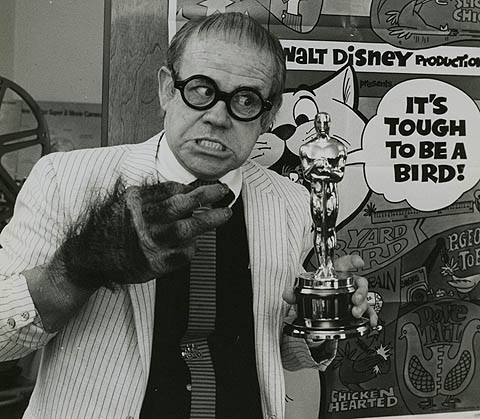
In today’s people assume voice acting is the easiest job there is. However, professional voice actors, like Billy West, will contend to that assumption. It’s not easy, it’s not like simply reading the lines and you’re done. No, you have to give a convincing performance with only your voice and not your body to help aid in emoting. Sadly animation studios keep giving voice acting parts to celebrities instead of professionals.
Assistant Director and Cutter
             An assistant director is neither an assistant nor a director. His duties involve record-keeping and ensuring technology runs smoothly. Every frame of the cartoon is controlled and perfectly in-synch with the voice track, music, and sound effects. A cutter helps keeping and marking the sound and voice synchs.
Character Model Department/Handout
Link
            It takes 24 drawings to produce one second of animation, if a studio is to produce an 80-minute film on time, a studio must assign a team of animators for each character that appears on film. In order to this, the Character Model Department hands out model sheets or sculptures to help aid an animator to animate the character consistently. Model sheets entail the dimensions, size, shape, movement, idiosyncracies and other little details.
Story Reel
            Similar to storyboarding, a story artist combines the storyboards with the voice tracks, music, and sound effects into a movie. It’s sort of like watching the “rough draft” of the film. The director would look at story reel and pinpoint areas that could be refined.
Layout
Link
            The layout man is responsible for the appearance of the picture, scene by scene. Kind of like an architect for animated films: “He works with the director on the staging and dramatization, building on the ideas of the story sketch. He designs the backgrounds, suggests the pattern of action for the animator, indicates camera positions for the most effective shot and the cutting that will tell the story in the most interesting way” (Johnston and Thomas, 1981, p. 212). In live action films, editors have the luxury of editing a film a certain way once all the material has been filmed. Animated films don’t have that luxury and everything must be planned out beforehand. This is a list of things layout men consider when working:
1.     One quick look is all the audience gets – keep it simple, direct, like a poster; it must sell and idea.
2.     Fancy rendering at a later date cannot save a poor original conception.
3.     Always keep screen directions clear.
4.     Keep informed on: art is history, architecture, costumes, landscapes.
5.     Keep informed on: styles, mediums, textures, surfaces, composition, drawing.
6.     Keep informed on: technical information – effects given by different lenses, ground glass, filters, gels.
7.     Mood can be established by timing and movement. For example, sad or quiet – long scenes with slow moves on pan, trucks, and characters. Happy or excited – short scenes, fast cuts, quicker moves on camera and characters.
Here are also four ways to plan and make layouts:
1.     Thumbnails. Gather whatever ideas being offered from the storyboards, later on they might become the basis for final layouts, cutting, and staging.
2.     Traditional. Devote time and thought into visualizing the actual layout so that there is consistent planning. Little changes are expected like extending the drawing so a slight pan move can be used, or moving furniture to make room for another character.
3.     Multiple choice. Visualize the scene from every angle to give the director and animators opportunities to pick the staging and layout they liked best.
4.     Long shot or establishing shot. Works similarly to backing shots in live-action film.
Experimental Animation
            When voices are recorded and the story sequences are approved, it’s then time to start experimental animation. Experimental animation is the period in which the supervising animator tests how the character will look, behave and what personality may manifest in rough animation. A perfect example of this would be the video I posted earlier featuring the experimental stages Disney took in creating Tarzan (see Technology and Techniques).
 Supervising Animator
            The supervising animator is the lead animator, responsible for the work done by the animators under him: “The supervising animator would talk to them about the character they were doing, exchange ideas on how to keep him consistent in appearance, suggest business that might fit into their section of the picture, or discuss further ways they all might develop the character. He might also commiserate when things went wrong or try to defend his animators if they were unjustly criticized” (Johnston and Thomas, 1981, p 224). The supervising animator also does the key poses in a sequence, then they are handed to his or her team to complete the motion. 
Assistant Animator
            Animators also known as inbetweeners. Their job is to clean up the animator’s rough key poses, details are consistent, the animation is always on model.
The Work Reel
            Like the story reel, where it’s storyboards compiled into movie format, the work reel is a compilation of rough animation. A popular term for this is “sweatbox,” in which the director, layout men, etc. review an animators work in a small heated theater.            
Effects Department
            When an animated film calls for a special effect, it goes to a branch of animators who specialize in them. If the film required things like fire, water, wave splashes, lighting and moving shadows, the effects animators would study the elements’ movement and behavior for inspiration. Then they would animate and caricature the effect needed for the film in layers. Fun fact: The Little Mermaid beat out Fantasia for most special effects used, attributed to the number of bubbles the film used.
Color
            Color is the most difficult aspect in an animated film. Johnston and Thomas (1981) reported: “Every color system on film has its own strengths and weaknesses that somehow must be mastered by the craftsman who wants to put his color theories on the screen. It is often an annoying and frustrating gamble but it is worth the effort if one is at all concerned with the appearance of the product” (pp. 268). Color is selected to add realism to the film, however, some choices may conflict with the background. For example, Johnston and Thomas (1981) noted that Captain Hook’s black hair blended in the shadows of the background, making him look like he was bald. In fact, Princess Ariel’s iconic color scheme of red, green and purple was chosen to avoid these issues. Ariel was originally imagined as blonde, the animators changed her hair for two reasons: 1. To avoid comparisons from the movie Splash, which featured a blonde mermaid. 2. Red hair was less taxing to shade or find alternate colors for different lights, especially since Ariel goes from underwater to the surface.
Ink and Paint
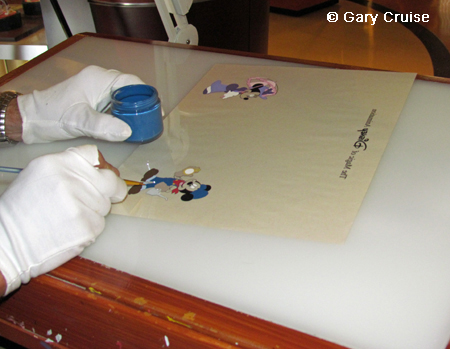
Link
            When animation is complete, the drawings go to the Ink and Paint department where they will be traced over with pens on one side, then the insides are colored in. The result is a complete animation cel. Overtime the process, especially the ink one, was really time consuming. The ink technique was done away with new Xerox technology, which allowed animators to ink their drawings with efficiency and retain the graphical designs that was usually overshadowed by the old technique. It was beneficial by the time Disney was making 101 Dalmatians which allowed the animators to efficiently create 99 Dalmatian puppies, especially because spots were hard to animate. Unfortunately, pencil marks and scratches were notoriously picked up by the Xerox process, which gave the resulting animation a very scratchy quality that was persistent throughout the 60s and 70s. This was done away when Disney began digitally inking and painting their animated features with the coloring CAPS system in the 90s, which allowed the graphic and efficient quality of the Xerox, but retained the beauty and elegancy of the old techniques.  

Works Cited
Johnston, O., & Thomas F. (1981). The Illusion of Life: Disney Animation. New York: Disney Editions.  

The Nine Old Men

The term “Nine Old Men” is ubiquitous in the world of animation and Disney animation alike. It was the moniker given to Disney’s core group of animators, who’ve worked with the company for roughly fifty years. In addition, they’re credited for refining the twelve principles of animation. The Group consisted of Les Clark, Woolie Reitherman, Eric Larson, Ward Kimball, Milt Kahl, Frank Thomas, Ollie Johnson, Johnny Lounsbery,  Marc Davis:
Les Clark
Link
            Walt Disney hired Les Clark in 1927, originally unsure how long Clark would last and believed that would last only as a temp. Clark worked for Disney until his retirement in 1976. Frank Thomas and Ollie Johnston (1981) noted Clark’s skill:
His drawings had appeal, were always gentle and warm and likable, and his timing was always sensitive. He quietly went ahead perfecting what he did best, constantly at art class working hard to improve and to learn. There was much adoration for this quiet, thoughtful man, who came in with no art background yet through sheer determination and desire not only kept up but helped advance the art with his refinements of many fundamentals. (pp. 168)
Clark was responsible for animating Mickey Mouse in Fantasia’s “Sorcerer’s Apprentice” sequence as well as the Sugar Plum Fairies in the “Nutcracker Suite.”  
 In addition, he was appointed Sequence Director on Sleeping Beauty.
Woolie Reitherman
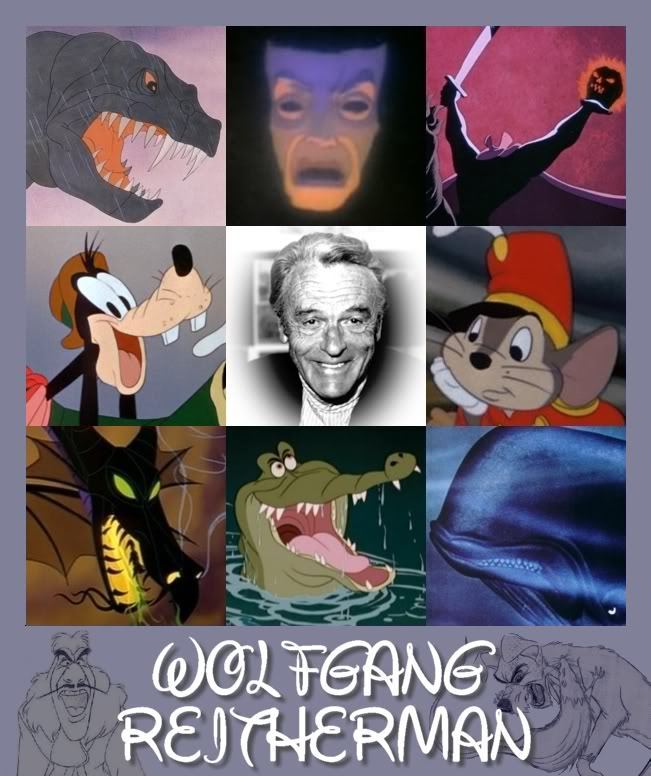
            Wolfgang “Woolie” Reitherman was described by his peers as, “the most physical of the group­ – with a compulsion to stay young and to squeeze in everything before it is too late” (Johnston and Thomas, 1981, p. 169). Reitherman’s work includes Monstro from Pinocchio, the crocodile from Peter Pan, and directed all of the Disney films after Disney’s death as well as responsible for animating and directing Goofy in the Goofy shorts. According to Thomas and Johnston (1981), “his timing, staging, texture, pacing, desire to do something different, good gag sense, knowledge of whether it was entertaining (and the ability to think of something else if it was not), all carried over into his directing” (p. 169). He was a ball of boundless energy that always provided fresh, new material.
Eric Larson
Link
            Eric Larson was talented at animating pantomime, Figaro from Pinocchio and the pegasi from Fantasia’s “Pastoral Symphony.” In addition, Larson worked on the rogue stag and the Old Owl in Bambi. Because of his history animating birds or flying creatures, Larson became known as a “bird-man” for being able render flying creatures with expertise.
Ward Kimball
            Ward Kimball originally started in character animation as well as animating beloved character Jiminy Cricket. However, he felt it was too stifling for his talent. Kimball found his true calling as the joker of the team:
Link
                        He was an excellent draftsman, with the rare ability to make funny drawings equally as well as serious ones. He had a better design sense than most and thought imaginative ways of doing things. He never did what was expected, and to the consternation of at least one director never did the assignment the way it was handed out. His staging was tops, his timing unique, and he could show what was funny about a situation. He had a knack for picking out the special, little noticed traits in almost everyone around him, and from then on that person would have a label on him. (Johnston and Thomas, 1981, p. 171)
Link
Milt Kahl
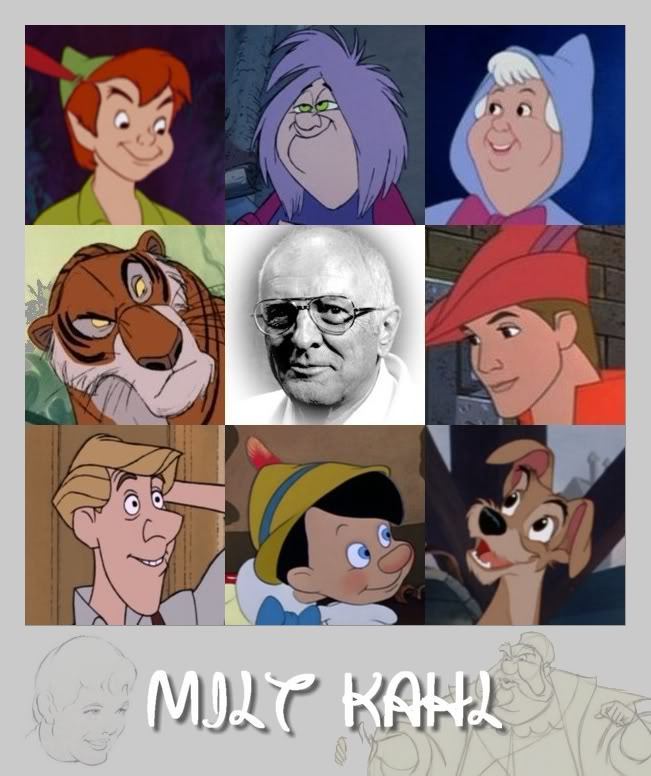
            According to Johnston and Thomas (1981) Milt Kahl’s greatest asset, “lay in his drawing ability and his conviction that animation drawings were really two-dimensional and should work in that plane – clear, simple, easy to read and understand” (pp. 171). Kahl was the most talented at being able to animate human figures without relying on live-action or the support of reference material. In addition, Kahl was noted for his eye in design, being responsible for Sir Ector and Kay in The Sword in the Stone and Madame Medusa in The Rescuers, the latter being his answer to Cruella de Vil and the final character he would animate before his retirement.
Frank Thomas
Link
            Frank Thomas, co-author of the book The Illusion of Life: Disney Animation, and fellow Old Man. Thomas is not as talented as an animator, nevertheless, he has been noted to have an analytical eye:
                        Like the rest of his fellows, Frank gave time to help others. His advice was sought on music, layout, background, and story as well as the animation. On the last few features, Frank would spend anywhere from six months to a year helping develop the story structure and situations, sharpening up and defining the characters and  their dialogue – and then he would animate on those same sequences with a fresh eye. (Johnston and Thomas, 1981, p. 174)
Thomas was also famous for his decades long friendship with fellow animator, Ollie Johnston.
Ollie Johnston
Link
            Ollie Johnston, co-author of The Illusion of Life: Disney Animation and fellow Old Man.
Colleagues agreed that Ollie carried acting and the feeling of the characters to the highest point. He had a sensitivity for good picture, imaginative layout, what the character should be doing, and how to arrange the scenes for the best effect. His knowledge of what was needed in a voice made him valuable in dealing with the difficult decisions of whether the vocal talent was giving the performance he must have to make the character think and act. (Johnston and Thomas, 1981, p. 174)
For example, Johnston was involved in animating the Queen of Hearts and trying to find that right balance between pompous ruler and violent womanchild, yet nevertheless finding the comedy and entertainment value out of it. In addition, Johnston was also famous in the world of animation for his decades long friendship with Frank Thomas.
Johnny Lounsbery
            Johnny Lounsbery was originally instructed by original Disney animator Norm Ferguson himself. However, Johnston and Thomas (1981) noted in more ways than one of the student surpassing the master:
Link
His better drawing and bigger concept, not limited by old vaudeville acts,   brought the bold, crude approach to new heights, using more refinement , more dramatic angles, more interest, and all without losing the main idea. His simple staging, appealing characters, good taste, strong squash and stretch, and controlled anticipations and follow through made a big bold statement, but they never lost believability. Hardly subtle, his characters were always fun to watch. (pp. 176)
Lounsbery’s favorite character he animated wa Ben Ali the alligator from “Dance of the Hours” in Fantasia. Lounsbery was noted by his peers to be an introvert though it never stopped him from asserting himself in key decisions. Also, he was very good in working with live-action and capable of blending it with cartoon action without losing the subtleties of either medium. Lounsbery passed away during the production of The Rescuers which he was serving as sequence director.
Marc Davis
Link
            Marc Davis slowly rose in Disney animation, starting with clean up and delicate drawings on Snow White to designing and animating Disney’s greatest villains, Maleficent and Cruella de Vil. Despite this, Marc was described, “a very gentle person, but with strong convictions that he holds to tenaciously” (Johnston and Thomas, 1981, p. 177). Johnston and Thomas (1981) note Davis’ tendency to the dramatic”

…the flamboyant Cruella de Vil made use of everything from her bony elbows to her posturing through her erratic movements….Maleficent, he showed a flair for the dramatic based more on powerful shapes in his design and strong use of color than on broad action. He had a feeling for the importance of a good layout and never overlooked the value of props such as the raven and the staff and made sure they were part of the overall picture. (pp. 177)


Works Cited
Johnston, O., & Thomas F. (1981). The Illusion of Life: Disney Animation. New York: Disney Editions.  

Sunday, March 2, 2014

The Four Animators

After being stripped of the rights to his character Oswald the Lucky Rabbit and losing most of his animation staff, Walt Disney had to rebuild himself from the ground up. Disney picked four new animators for his new studio and these animators stayed with him for most of the Golden Age of Animation.
Norm “Fergy” Ferguson
            Norm Ferguson was an ex-camera man turned animator in 1929. An introverted man from Brooklyn (judging by characteristic Brooklyn accent), Ferguson tastes delved into vaudeville comedians that influenced his animation. Ferguson animation style is very broad and expressive, giving his characters the impression that they’re thinking. Ferguson’s most well known example of this is Pluto, Mickey Mouse’s dog:
The famous flypaper sequence from Playful Pluto, a milestone in personality animation. From the time he accidentally sits on a sheet of the sticky flypaper, Pluto’s problems seem to become ever worse as he tries to extricate himself. Thrown it all, his reaction to his predicament and his thoughts of what to try next are shared with the audience. It was the first time a character seemed to be thinking on the screen, and, though it lasted only 65 seconds, it opened the way for animation of real characters with real problems (Johnston & Thomas, 1981, p. 100).

Despite not having formal art training, his peers list this as a benefit because Ferguson would not inhibited by anatomy and drawing rules.
Ferguson would later go on and animate The Evil Queen’s hag/witch form during the production of Snow White and the Seven Dwarfs. Veteran Disney animators Frank Thomas and Ollie Johnston emphasize the Witch becoming Ferguson’s most iconic characters: “Fergy’s handling of her face was less of a typical formula than most Disney designs, with shapes that did not relate as well as they should for animation because of the witch’s illustrative quality. The mouth to cheek to eye and brow relationship, which is so important in animating expression changes, suffered from his concept in design” (p. 105). By 1953, Ferguson found it increasingly difficult to keep up with Disney and left to work at other studios. He died in 1957 after being plagued with diabetes and other health problems.
Hamilton “Ham” Luske
            Out of the four original animators, Hamilton Luske was the only one with a college education. A graduate of University at Berkley majoring in business yet his only formal art training came from the classes that Disney initiated. It should be noted that Luske struggled with drawing, yet excelled in animation, story, and had a keen eye for entertainment, which helped make up for his lack of artistic talent.
In contrast to Fergy’s natural ability to improvise while animating, Ham always seemed to follow a procedure with a step-by-step approach. However, his animation was not mechanical in any way. On the contrary, it was full of life and the feeling of the character; his ability to move the audience with his pathos was second only to Bill Tytla’s. Ham could not start a until he had the whole thing visualized (Johnston & Thomas, 1981, p. 110)
Luske’s talent resided in fleshing out character action relationships or looking at designs and finding ways to improve them, “an example of inventing business for a character occurred is the scene where Snow White folds her arms as Grumpy would, while she is watching him. It was a very good choice of action for her, because it showed her gentle way of teasing Grumpy” (Johnston &Thomas, 1981, p. 114-115). Another instance, Luske believed the rabbits done by Disney looked too thin and bony and insisted soft and furry. After several redesigns, the artists at Disney managed created soft and furry rabbits in the form of Thumper. This design technique would later be used for Michael of Peter Pan.
            In 1938, Johnston and Thomas report what Luske once shared on his thoughts of animation:
Our actors are drawings. We cannot work on the inspiration of the moment as an actor does, but must present our characterizations through a combination of art, technique, and mechanics that takes months from the conception to the finished product. And we have to make the audience forget that these are drawings. We cannot risk ruining a sequence ruining a sequence or a good characterization with some mechanical imperfection or jitter that reminds the audience that are dealing with drawings instead of real human beings. (p. 113-114)
             Hamilton “Ham” Luske continued to direct more animated films and sequences, including the cartoon section of Mary Poppins. However, more of his time was increasingly spent on live-action TV shows, until his death in 1968.
Fred Moore
            Fred Moore was one of Disney’s favorite animators and artists. Hired at the age of eighteen with only limited education based on art classes he took as well as working as a janitor at the time, Moore eventually became one of the few first to break rubber hose style animation. Despite his limited training, Moore still turned out to be a talented artist, popular for his provocative drawings and sketches of girls, as well as never being noted for making a bad drawing. Thomas and Johnston note Moore specialties
The squash and stretch of the walks that Freddie animated had more life, felt better, looked better, and probably seemed more real just because of his ability to change shapes. He had such a simple, clear way of showing the straight leg, the bent leg, the shove off, the highs and lows of the walk. He did not experiment with a walk in the same way Ham did, varying the timing and the relationships to get something unique, because Freddie’s was all feeling (p. 126).
Disney favored Moore to the point that he asked all of his other artists and animators to model after him and it can be argued that Snow White and the Seven Dwarf is based on his style because of it.
Snow White Rough Poster by Fred Moore
            While there are twelve principles of animation, Moore had his own personal fourteen points of animation:
1.     Appeal in drawing.
2.     Staging.
3.     Most interesting way? [Would anyone other than your mother like to see it?]
4.     Is it the most entertaining way?
5.     Are you in character?
6.     Are you advancing the character?
7.     Is this the most simplest statement of the main idea of the scene?
8.     Is the story point clear?
9.     Are the secondary actions working with the main action?
10.  Is the presentation best for the medium?
11.  Does it have 2 dimensional clarity?
12.  Does it have 3 dimensional solidarity?
13.  Does it have 4 dimensional drawing? [Drag and follow through].
14.  Are you trying to do something that shouldn’t be attempted? [Like trying to show the top of Mickey’s head]. (128)
Like Norm Ferguson, Fred Moore left the studio despite the innovations he contributed, because he couldn’t keep up with the changing standards and feeling like he accomplished too much in too short a time, “I have reached everything I want, and I’m only twenty-four. Now what do I do?” (Johnston & Thomas, 1981, p. 129) Tragically, Moore died in an auto accident in 1952 at the young age of forty-two.
Bill Tytla
           Bill Tytla was known to be a very intense person. Dark, brooding, physically fit, emotional yet socially awkward. Nonetheless, this animator will forever be known as the supervising animator for Chernabog in the “Night on Bald Mountain” sequence of Fantasia. Tytla’s talents lie in his character’s acting from the violent, mercurial moods of Stromboli from Pinocchio to capturing the dark, terrifying power of Chernabog. As Thomas and Johnson noted on Chernabog’s character, “Powerful action, solid drawing, and dramatic staging helped to create a character never even attempted previously in animation, but it was a feeling of an inner spirit, evil and primitive, that really made him live on the screen” (Johnston & Thomas, 1981, p. 131).
          
Animators usually hire actors to act out scenes in a feature to better understand how they want sequence to play out or as reference material. For the “Night on Bald Mountain” sequence, they hired Bela Lugosi of Dracula fame. Once filming was done, Tytla expressed displeasure at the scenes Lugosi filmed and eschewed them all in favor of doing the reference material himself.
            When working, Tytla would always try and produce his best material. His dedication is best exemplified when his ego was crushed when Disney told him the scene he did was “Ok”. A week or two later, Tytla would rethink that scene and return with something twice as good.  
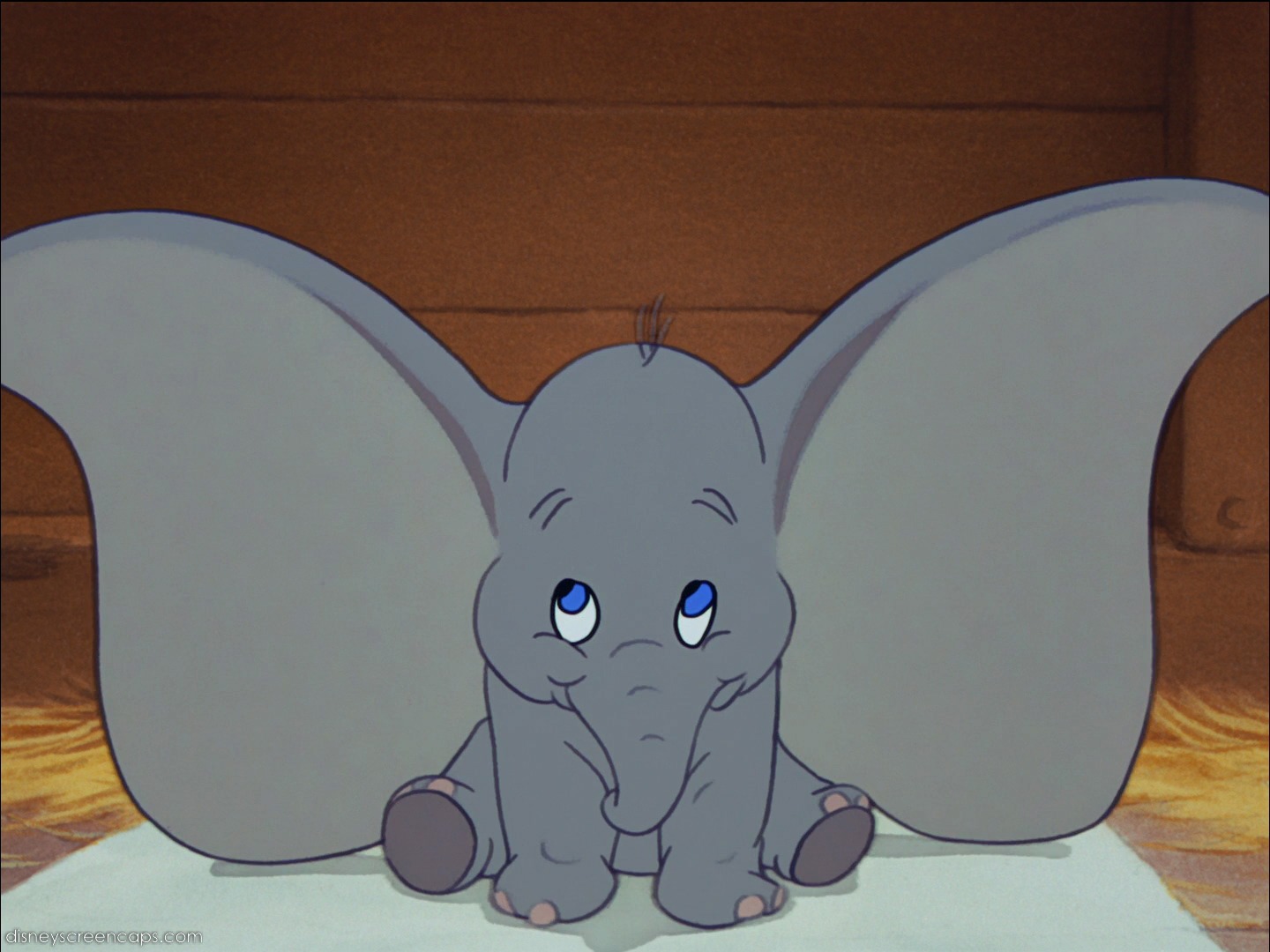
 Chernabog would become his magnum opus to the point people who personally knew Tytla would be shocked with disbelief that he worked on the sequence as it contrasted greatly with his other work like the Dwarfs or tender scenes involving Dumbo.
            Bill Tytla retired from animation in 1943 and he and his family moved to Connecticut where he felt they’d be safe during wartime America. From then to his death in 1968, people felt he never had the same self-fulfillment and gratification he found while working for Disney.

Works Cited

Johnston, O., & Thomas F. (1981). The Illusion of Life: Disney Animation. New York: Disney Editions.